About a week ago I finished playing Persona 5 and I wanted to talk about it here, mostly because I started this blog to practice talking about games that not only I found interesting from a design perspective, but also talk about any game I played from a design perspective. At first I tried to write this out as a comprehensive analysis, but eventually scrapped that idea and just went with a more free floating thought session instead since it was easier to do in my lunch breaks. (No time at home, gotta start Zelda.)

1. A Narrative Game Loop
Back in the mid 2000’s, one of the biggest gripes with the games of that era was that there was too much of a divide between the game’s gameplay and the game’s narrative. Many games were set up to play a level, then watch a cutscene. At most, maybe there was a little banter during gameplay to help build character, but all important plot points were done through prerendered movies involving no more interaction from the player than simply watching. In response, games have been trying many ways to make the narrative and gameplay blend into the same experience, with many studios trying and finding different interpretations to accomplish that. Bioware dove into branching narrative paths, making each dialogue a choose your own adventure novel. Naughty Dog made games that are more aptly described as interactive movies.
Persona 5 adds the narrative into its main game loop. In fact, its narrative is the focus of its game loop. Whereas most JRPGs fall into a loop of explore places -> fight monsters -> watch the story, Persona completely shifts things around. Stats no longer determine your character’s fighting ability, but rather which of many side plots are available to pursue. Interacting with those side plot narratives are what gives you more power in the actual combat portion of the game.

The end result is a game that’s nearly impossible to put down. Every in-game day is a new possibility for rewards. Talk to the kid with the bullying problems and gain new gun skills, or watch a scary movie to gain enough Guts points to talk to the store owner, all wrapped in a very deliverable story package. Even though I’ve had the opportunity, I’ve never played a Persona game until now because the idea of faffing around being the bulk of a 100 hour game seemed, frankly, mind numbingly boring. In reality the faffing about was the best part, and I don’t think it’s because I found the story of a classmate’s self-esteem issues to be the most fascinating thing I’ve heard in a long time.
2. Weirdly On-Point
Persona 5’s story feels like it was penned yesterday. Its main theme is breaking free of the various oppressive systems in society, be that an abusive teacher who goes unpunished for being the star of the school, or a businessman who overworks his employees, or a corrupt Prime Minister who goes unopposed because… politics. I’m going to have to give this one to sad irony that a game in production for six years was able to hit the nail right on the head for what young adults are feeling within the last year, from a terrible job market to politicians ignoring their own town halls. It’s a shitty time to be powerless and Persona knows it.
An interesting example is the aforementioned Prime Minister, who I can’t help but wonder if he was left somewhat bland on purpose. Acting as the main antagonist, there wasn’t anything special about his character. He wanted to become a politician for personal gain. He was surrounded by a bunch of yes men who wanted to ride his success. That was about it really. But as consequence, I was constantly projecting the character as a younger, more affluent version of a certain president. And regardless of political views, you can probably think of a politician who you believe fits the bill.

I also thought it was interesting to see the idea of adults vs teens being pushed so hard in a game made primarily by adults in favor of the teens. To the wrong audience it may come off as preachy, but just about everyone I know, myself included, has had times in their childhood where their age was a major factor in being mistreated.
3. Shin Megami Tensei’s Franchise Approach
I’ve played several games in the Shin Megami Tensei franchise, the franchise of which Persona spun off from, and it’s all started to get a bit familiar. In particular, the combat system is almost cut and paste from game to game. It’s not a bad combat system by any means: it’s close enough to the vanilla JRPG turn-based fare that it’s easy to pick up, but also has enough variance that it doesn’t get boring. And there are a few tweaks to the system from game to game, but for the most part if you’ve played one SMT game, you automatically know the battle system for every SMT game.

This isn’t a bad approach. It’s clear Atlus is far more interested in telling Angels and Demons stories and coming up with new systems to wrap it up in than reinventing the wheel each time, and I’m certainly a fan of “If it ain’t broke don’t fix it” mentality. But I can’t help but wonder what would have happened if Persona was its own franchise, completely separate from the SMT games before it.
The Personas, physical manifestations of the true self according to the game, probably have the most disconnect. In other SMT games, they’re demons. But mechanically they’re exactly the same across all games. For a game thematically about wearing personas as a mask, they have surprisingly little to do with the narrative. There’s some boosts in the narrative based on which Personas you’re currently equipped with, but it’s minor. The low hanging fruit would be for each Persona to help or hinder the narrative stats I talked about it part 1, the high hanging fruit would be for the main character’s personality to change based on equipped Persona.
In fact, the Personas feel more like actors playing a role than a believable monster in the Persona world. Like watching Tom Cruise pretend to be anyone other than Tom Cruise. The fact that all the Personas are named after and look like horrific demons is really just fuel for comedy fan art.
But hey, the game gets near perfect scores, so if it ain’t broke don’t fix it.
4. That UI

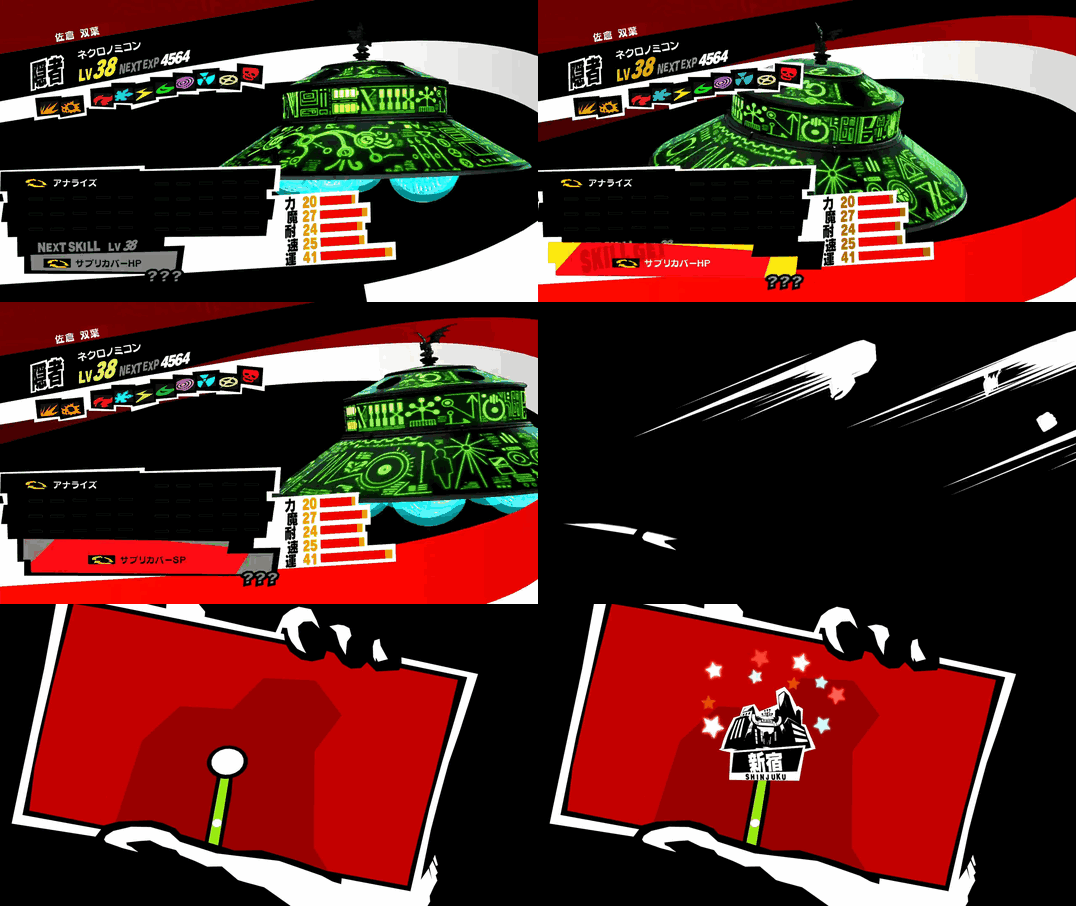
I have never wanted to be a UI artist until this game.
 Digital Devil Designs