I finally played Telltale’s The Walking Dead (yes, six years late on that one) and I was heavily impressed. Something I’ve heard from people who’ve played a lot of Telltale and Telltale-like games is that after a while, the illusion of the Telltale game wears off. The game promises you that the decisions you make effects the story, but how much of that is actually true can vary. Unfortunately, due to the nature of games and game development, this is very difficult to pull off as expected. If a story has a major branch, then you have to develop two stories, despite the player only seeing one. In a worst case scenario, you only get 1/n the amount of content seen by the player compared to a linear game of the same development cost.
There are ways to mitigate this, but the question always comes down to “how does a designer make choices matter?” Though I wouldn’t consider myself a connoisseur of Telltale’s and their competitors’ games, I have played them, listened to others discuss the issue, and even interviewed other designers who explained some of their process making these games, so I’d say I wasn’t exactly going in blind. But despite all this, I’d still say that, even though the story stayed roughly the same throughout the entire game, the choices I made in Telltale’s The Walking Dead did matter.
To explain, I figured I’d break up The Walking Dead’s choices into several categories, and explain how The Walking Dead uses them to great effect. Note that sometimes a choice can belong to multiple categories.
Type 1: The Branching Choice
This is what most people think of when they think of a “choice that matters.” It’s a choice that makes good on the promise up front, that your choices effect and change the game. After making one of these choices, the story splits. Do you walk the streets during the day, or at night? Do you save Carly or Doug, leaving the other to die? These choices also come with a lot of baggage, as I explained above. It’s extremely difficult to have more than a handful of these types of choices.
One successful use of this choice is whether the player saves Carly or Doug at the end of episode 1. Though both characters end up fulfilling the same role in the story after the branch, there’s enough to differentiate them that it feels like choosing one over the other made a significant difference. Save the sharp-shooter Carly, and she’ll take out a few zombies, talk about main character Lee’s past with him, and do some flirting on the side. These are all events that couldn’t take place with Doug in her place, which makes them feel significant, even if the story gets to the same place regardless.
A less successful example is whether to leave Lilly in the middle of episode 3. In this choice, the player must decide if she wants to leave Lilly behind after she snaps and murders another member of the team. It could be argued that this choice falls under a Type 2, and I agree that it is that too, but in deciding to keep Lilly the player is knowingly taking a risk. Having that risk recognized with an outcome that only Lilly could provide, either good or bad, would be an expectation when choosing to keep her in the group. Unfortunately, Lilly just decides to leave on her own twenty minutes later after being shunned.
Type 2: The Introspective Choice
The introspective choice is one where the end goal is simply to allow the player to think about what kind of person she will be in a scenario so obscene, she’ll probably never have to face it in real life. The Walking Dead is almost too perfect a setting for this type of choices, as survival starts to trump societal values. Do you shoot a woman to spare her a much more gruesome death, knowing that the sound of the gunshot will attract nearby zombies? Do you throw out the weak or dying to save yourself?
I’d argue that this type of choice has the biggest bang for its buck. Not only does it force players to think about abstract problems, but it’s fairly easy to show the consequences of such actions without extending the scope nearly as much as a Type 1 choice. One way The Walking Dead does this is by having two or more characters take different philosophies. Should you kill someone who is dying before they become a zombie? Chances are, two different characters will argue the points for and against before you have to make your decision. The character you agreed with will pat you on the back, the one you disagreed with will resent you. These choices don’t promise large changes to content, just some dialogue differences for the rest of the scene and a few points afterwards.
Sometimes this choice is shown by pitting a mechanical advantage against what’s considered a good, or correct choice. You can make the game a bit easier if you ignore the pleas of a woman. Being a game light on mechanics, The Walking Dead doesn’t have too many of these opportunities, but it is a great way to cause an introspective choice.
That said, a Type 2 choice that doesn’t also qualify for another category can feel shallow. In episode 5, Lee has the choice to chop his arm off in hopes that it will stop his zombie bite from spreading. It’s a big question: would you chop your arm off for a chance of survival? But by episode 5 the player is well aware that Lee will make it to the end of the game regardless. Thematically, he’s definitely dead. Even the other characters aren’t particularly opinionated either way. So in the end it’s just a one-way question that the game isn’t interested in discussing with you either.
Type 3: The Emotional Choice
The emotional choice is a choice that has no meaning outside of being important to the character. Sometimes this doubles as a mechanic, as some characters will act differently depending on how nice you have been to them, but honestly the most memorable moments for these choices were when no mechanical advantage was tied to them.
Do you high five a ten year old to be “totally awesome” in his eyes? You better believe you do.
These types of choices become very prominent in the final episode of The Walking Dead, assuming you brought most of the characters along for the episode. Despite knowing it’s the last episode, and the characters’ fates have been pretty much sealed, the game gives plenty of opportunities to sit down to chat and smooth things over with characters you might have disagreed with throughout the game. A big factor in how this works so well is the UI, specifically this message here:
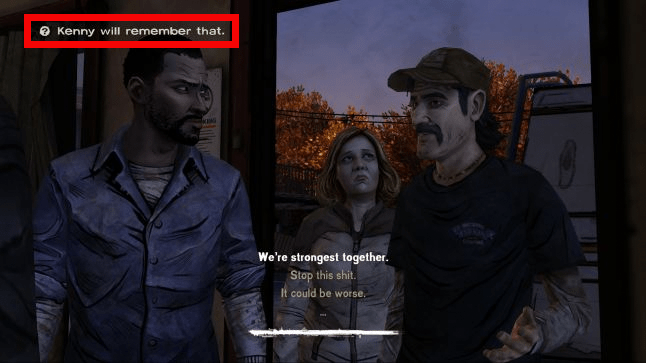
When you first see this message, it signifies that a choice you made will be referenced later. Lie to Kenny about your background: “Kenny will remember that.”
Apologize to Kenny about the time you beat him up on a train: “Kenny will remember that.”
It’s very subtle and very effective.
Tangential to the subject, the UI is an excellent way to bring some unexpected emotion into a choice. The alert UI usually has a handful of stock messages, so when one comes up that is out of the ordinary, it really leaves an impression. Sure sawing off your arm sounded like a good idea, but when the game responds to your decision with the very stark “This is going to hurt,” maybe it wasn’t such a good idea…
Type 4: Testing the Waters Choice
This choice is usually seen as filler. Not every conversation can lead to great sweeping emotions or big explosive consequences. However, The Walking Dead makes use of this filler as a way to test the waters of what the consequences of those other big, important choices could be. How do certain characters react when you disagree with them? Do they bring up good counterpoints? Do you still agree with your original answer?
Type 5: The Thematic Choice
Probably the least used, but still important, is the thematic choice. I can think of three times (arguably two are the same) when a big choice was very thematically important. These choices came at the end of an episode and, when analyzed, almost serve as a test to see if you learned anything from the episode.
The first two come at the end of episode 2. In it, the group is running low on food and decides to check out a nearby dairy run by a kindly mother and two brothers who agree to take your group in. However, things don’t seem quite right, and it turns out the family is only surviving by hunting and eating other humans who they draw in with the promise of food. At first it might seem like this is an extremist way of survival, but on closer inspection the player learns that it’s really just a cover for the family to justify their violent nature. Regardless of your views on cannibalism when desperate, there’s no humane way to eat another human, given that they turn into zombies very quickly after death. I mean, other than there’s no humane way to eat a human, full stop.
At the very end of the episode, the player has the option to kill one or both brothers. The choice doesn’t effect anything. One brother gets his leg caught in a bear trap that can’t be opened (foreshadowed at the beginning of the game) and the other is left weaponless and vastly outnumbered. At this point, there’s no reason to kill either of them, unless you consider being speared by a pitchfork to be a kinder way to go than mauled by zombies. The game is subtly trying to tell you that killing the two brothers, as terrible as they are, is a senseless act of violence, something the game has been condoning the entire episode. The choice then is whether or not you recognize it.
This type of choice happens again at the end of chapter 4. In it, the team ventures into a community that survived by killing or exiling the weak: those sick, wounded, pregnant or children themselves. Obviously such a community is constantly condemned, but the final choice is whether to leave Ben, the college student who consistently gets into trouble and never pulls his weight, for dead. At the time it seems like it might be a good idea, he certainly causes more trouble than he solves, but then you’d be like the community you so despise. Again, the choice is a test. Do you really disagree with their methods?
Type 6: The Choice with Unexpected Importance
Lastly, this type of choice seems like a small, filler choice that has little meaning. Or has some meaning, but the consequence comes back outside the scope you were expecting. You made a choice, nobody talks about it, moving on.
And then it comes back to bite you.
This choice is very enticing but also very easy to get wrong. It’s very easy for the player to feel cheated if a choice about drinking water or milk gets someone killed. (No that choice doesn’t appear in The Walking Dead, I just couldn’t think of a poor example.) However, The Walking Dead does this well at the very end of the series. It dedicates a character to confront the player about every decision that was morally poor, some of which seemed rather minor at the time. His beef with the main character? He owned the car that you pillaged at the end of episode 2, an event that is never brought back up and, at the time, seemed like a throwaway event that explained why the cast didn’t starve after not eating their meal of human flesh.
I can’t imagine every Telltale-like doing this at the end of every game, or else it would start to get very old and very cheap, but it definitely is very powerful.
–
Of all these types, I think it’s important to realize how often each can be done to make the game feel fulfilling while staying within design constraints. As such, I propose this general roadmap for planning out what types of decisions you want, assuming a Telltale length episode of about two hours of gameplay:
Ideally, end the story on a Type 5. Obviously this only works if the episode has an overarching theme to it, but those episodes tend to be more memorable so I’d recommend pushing for one.
Scope out your ability to make Type 1 choices. This is the type players expect so being able to deliver on them as much as possible is recommended. I’d say about three to five of these choices are expected per episode, but the impact of each can vary. Ideally, each Type 1 choice should lead to some consequence that could not have occurred without making such a choice. This can be as small as receiving an item, a boost to gameplay, or a short branch of dialogue; or as large as having one character die to save the other.
Type 3 choices should be used when appropriate. Due to writing there should be opportunities to agree with, comfort, or otherwise connect with the other characters. Even if you expect the player to select the kind option, giving her the option to do so makes the gesture feel more genuine.
Type 4 choices should come naturally during down time. If the designer finds a lot of time for filler dialogue, use it as an opportunity to add more Type 4 choices.
Type 6 should be used extremely sparingly, perhaps only once every other episode. Too many Type 6 can make the story feel unrewarding, unpredictable, or that the choice never really mattered.
Type 2 should be used in conjunction with other types. It’s difficult to make too many Type 2 choices, but without another type to lay it over they can feel shallow. If you find yourself with a lone Type 2, try to wrangle it into a Type 3 or 4 as well.
 Digital Devil Designs