There’s this theory in game design called “Emergent Gameplay.” It’s basically our Holy Grail. Emergent gameplay is when players find ways to play your game that you, as the designer, did not intend. Some examples are Twitch Plays Pokemon, where two thousand players all tried to complete the same game of Pokemon Red, or anything you do in Minecraft. The great part about emergent gameplay is that it’s personalized to each player and you, the designer, didn’t have to lift a finger.
That said, emergent gameplay is really hard to design for. Generally speaking, claiming that you’re designing specifically to encourage emergent gameplay, then you either have some serious designer cojones or you’re handwaving bad game design, saying “don’t worry guys, the players will do it for us.” It’s not impossible, Minecraft and GTA 5 come to mind, but it’s very difficult.
Emergent narrative is the story-driven sister to emergent gameplay. The story in-game may not be very deep, but if the player makes up her own story as she goes, then you have emergent narrative. Again, it’s not easy to design for.
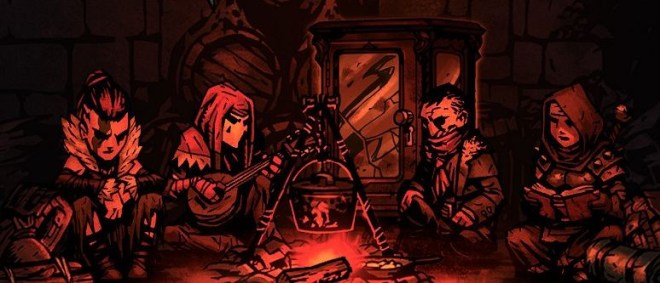
That said, I think Darkest Dungeon does a really good job in giving just enough for emergent narrative to form. The story itself isn’t particularly deep: you have to reclaim your home from Eldritch horrors by assembling a group of heroes to explore dungeons. The characters are mostly randomly generated and entirely expendable. The only thing you’re given with them is a name, class, starting abilities, and a list of quirks that will help or hinder their ability to fight.

And these quirks are a riot. Even though they serve a gameplay purpose, just a single descriptor breathes life into these generated characters. They’re also pretty talkative, even though most of the dialogue is generic and repeated. But if the stars align, you get some pretty funny scenarios.
As an example, I recruited Jubert the Plague Doctor for a suicide mission in order to gain some more money after an important mission went south. I only gave his team the barest of provisions and planned to abandon the mission as soon as they were on the brink of death. However, the little suicide team did far better than expected and was even able to complete the mission, even though two characters died in the final battle. Jubert returned a full level stronger, but gained the quirk “witness,” which said, to paraphrase, “will not pray due to having seen some shit.”
Or the time I brought a new Occultist who had an immediate mental breakdown and started verbally berating the rest of the team, who just kind of… let him bleed to death.
Or the fact that my holy, stalwart Crusader constantly pulls the cowardly lines from the shared dialogue.
Or that one of my Vestal (Virgins) will only “de-stress” in the brothel.
I recently watched a video explaining the large amount of romantic fanart being drawn for Overwatch, and it seems to be the same phenomenon. The conclusion drawn there was to give players just enough information for them to draw a rich backstory… and stop. For players to be willing to fill in the blanks, they have to be left wanting more.
 Digital Devil Designs
At the Darkest Dungeons postmortem at GDC, the founder explained that the game is heavily inspired by managing burnout in the crunches of the games industry. He wasn’t being funny then. He was feelong burnout, and thought it might make a good game to be a manager that has to keep a team sane in this kind of stress.
LikeLike
I can definitely see that.
LikeLike