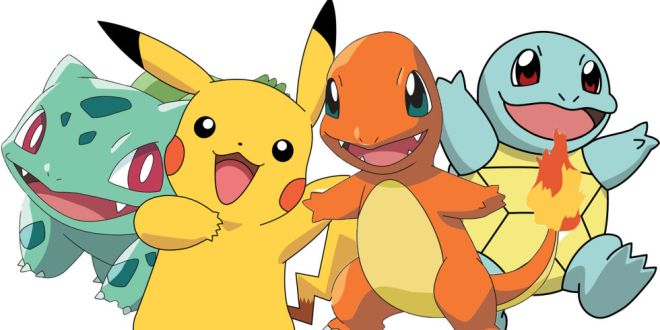
Pokemon. Just this past year it celebrated its 20th anniversary since releasing the original Pokemon Red and Green games in Japan. Since then it’s become a huge multimedia and cultural phenomenon. It consistently releases best selling and highly reviewed games, not just in its mainline series but also in its numerous spinoffs as well. Just take a look at Pokemon Go. And it’s got a complete monopoly on the monster-capture-battle RPG sub-genre (sort of.) Try and release anything involving cute little creatures fighting for you and you’ll instantly be labeled a Pokemon clone.
And frankly it gets a huge snub by the design community.
Try to look up anything about the game design of Pokemon and you’ll only get a small handful of fans who try to explain why Pokemon is so successful. And, you know, they try. They tell you it’s because Pokemon are cute (because video games are on a shortage of cute characters) or that the world is immersive (not particularly, at least in the original games.)
If I had to risk my design career on a single statement, it’d be this. The original Pokemon games, and every game thereafter, is a success because everything in the game is focused on fostering an emotional bond with your creatures.
And I mean everything, right down to the very numbers that define your Pokemon. Each Pokemon has standard rpg stats, like Attack, Defense, and Speed, but each of those stats are calculated using a variety of hidden values. Two of those values, effort values and individual values (also called EVs and IVs respectively) are specifically designed for that emotional connection.
Every new Pokemon you catch starts with zero EVs. EVs are gained by battling other Pokemon. For every four EV gained, one point is added to the respective stat. Through this method, Pokemon you catch and battle with are always stronger than an otherwise identical Pokemon found in the wild, and the longer you battle with that Pokemon, the wider the advantage gets. And stronger trained Pokemon become more reliable than switching them out with a new wild Pokemon.
IVs, on the other hand, are like Pokemon genetics. Every time a new Pokemon is generated in the game, its IVs are randomly rolled between a value of 0 to 32. A Pokemon with 0 IVs in its Attack stat will have a lower Attack than an otherwise identical Pokemon with 32 IVs in Attack. Because IVs are randomly generated, this is the hardest value for a savvy player to intentionally manipulate.
The point of IVs then, is to create individuality between Pokemon. Individuality creates a sense of ownership, which ties into that emotional bond. It’s not just a Charizard, it’s your Charizard. And your Charizard hits just a little bit harder than your friend’s Charizard, even though they seem to be mostly the same.

Then we have your starter Pokemon. In seven generations and 20 years, the starter Pokemon choice has remained exactly the same. You get your choice of three unique, overpowered Pokemon, in your favorite flavor of Grass, Fire, or Water type. The uniqueness comes from the fact that you can’t get any of these Pokemon elsewhere in the game, unless you trade your friend for one, and it plucks the same emotional chord as the IVs. Having your first Pokemon be, on average, more powerful than all the surrounding Pokemon ensures you stick with it long enough to develop that emotional connection, instead of swapping it for a Ratatta. It’s the friend that always comes through for you.
In part two, I’ll explain some of the challenges in designing a Pokemon-like game. To spoil a bit for you, one such challenge is making Pokemon obtained early on, Pokemon that are supposed to be relatively easy to defeat, viable for much later in the game. To clarify, you can tune up your Subaru as much as you want, but eventually you’ll have to trade it in for a Porsche. Pokemon evolution fulfills this requirement of trading in a weak monster for a stronger one, and even wraps it up in a nice bit of lore that it’s not a replacement Pokemon, the Pokemon is just growing up. You know, like real life.
The difficulty curve in Pokemon games boost the effect as well. Generally speaking, Pokemon games have a history of erring on the side of being too easy. There’s several reasons a game would want to be on the easier side, but for Pokemon specifically, it ensures that no matter what Pokemon you’ve fallen in love with, it can be used right up to the final battle.

Since the original games, many features have been added for that emotional attachment as well. The highly popular feature of having Pokemon follow behind your character is a purely aesthetic addition, turning your Pokemon into even more of a loyal companion. Completing the highest ranks of a Pokemon Contest in the third generation will reward you with a stylized picture of that Pokemon. Stickers in the fourth generation allowed for customization every time you send a Pokemon into battle. And perhaps the most popular addition: getting to pet, play, groom, and feed your Pokemon macaroons. If that doesn’t make you gush over your Pokemon like a new puppy, then nothing will.
None of this should sound terribly surprising. After all, emotional attachment to characters in a game is a pretty obvious design goal. But stay tuned for part 2, where I go over how difficult it is to make a Pokemon-styled game without directly copying its design, how its competition attempts it, and possibly why none have been able to hold a candle to Pokemon’s complete rule.
 Digital Devil Designs
Of course the Pokemon games are popular! Just look at those cute little guys.
LikeLike